

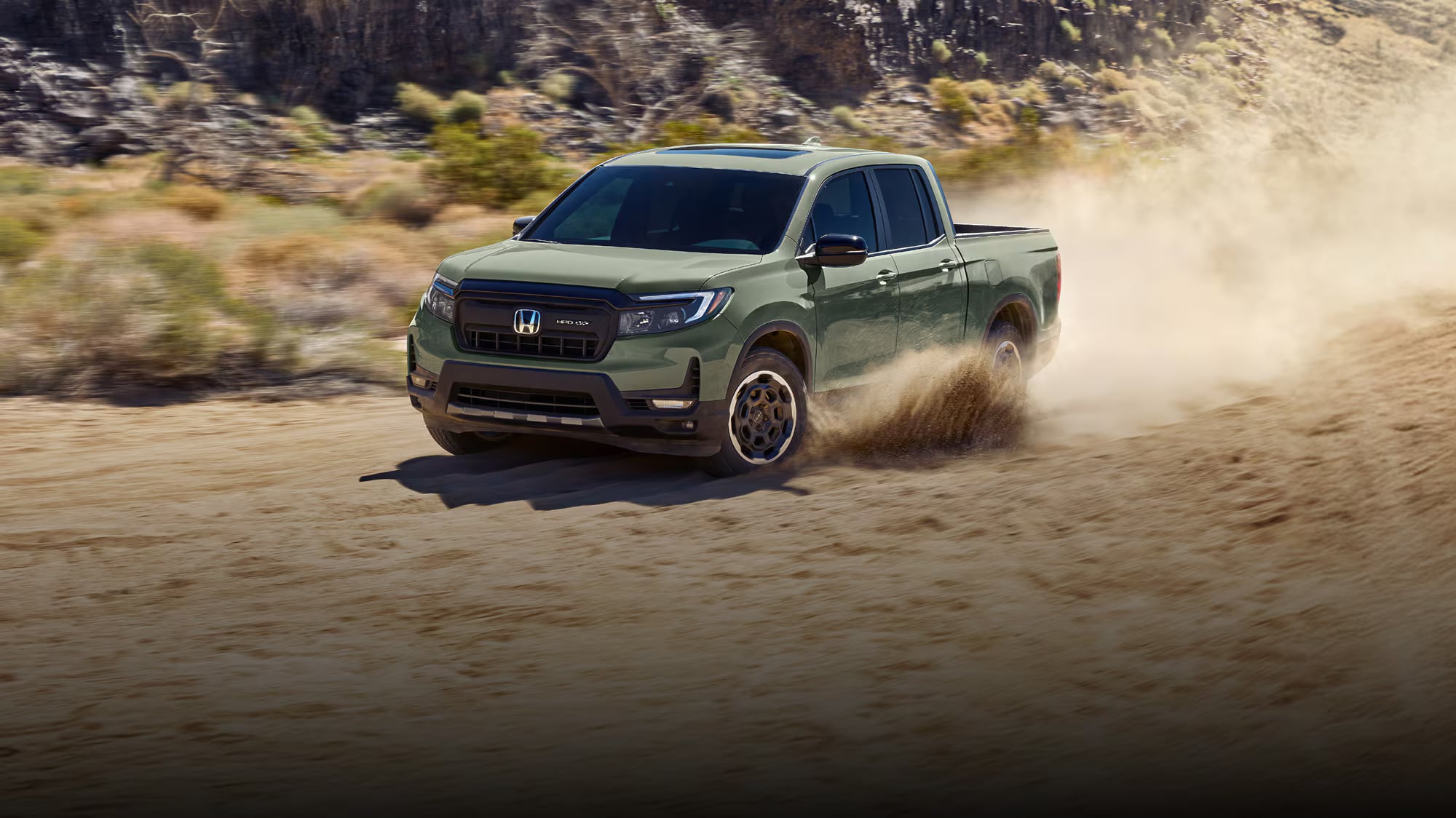
The Honda Ridgeline matches or exceeds the Toyota Tacoma for daily hauling, cargo security, and road handling, while trailing the Tacoma on extreme rock crawling and maximum tow ratings. Built with a unibody structure and standard i-VTM4 all-wheel drive, the 2026 Honda Ridgeline pulls up to 5,000 lbs and carries a payload of up to 1,521 lbs, satisfying virtually every routine truck task with far superior passenger comfort and ride stability.
Mid-size truck shoppers often debate whether a traditional body-on-frame truck like the Tacoma or an advanced unibody vehicle like the Ridgeline delivers better daily capability. While the Tacoma relies on a conventional rear leaf or coil spring solid axle setup suited for technical boulder trails, that architecture creates a stiff, jittery ride on paved highways. The Ridgeline utilizes four-wheel independent suspension and high-strength unibody construction, yielding sharp cornering, composed highway cruising, and zero bed shake over expansion joints.
Both trucks handle heavy chore duty, but they distribute their strengths differently. The Tacoma offers higher tow package maximums on paper for small commercial trailers, yet the Ridgeline includes standard towing gear right out of the box, including an integrated Class III hitch and a 7-pin connector. If you are comparing both trucks in person, stop by our showroom at 4011 Clemson Blvd, Anderson, SC 29621, or reach out to our staff with a quick call to discuss how each truck handles your specific towing and payload requirements.
Table of Contents
- How Does the Honda In-Bed Trunk and Payload Compare to the Tacoma Bed?
- How Does Honda i-VTM4 All-Wheel Drive Perform Against Toyota Tacoma 4WD?
- Cab Space and Passenger Comfort: How Does Ridgeline Compare to Tacoma?
- Towing Capacity, Fuel Economy, and Value: Ridgeline Versus Tacoma
- How Do Crash Test Safety Ratings Compare Between Ridgeline and Tacoma?
- Frequently Asked Questions About the Ridgeline and Tacoma
- Compare Your Truck Options at Piedmont Honda
How Does the Honda In-Bed Trunk and Payload Compare to the Tacoma Bed?
A lockable, weather-sealed In-Bed Trunk adds about 7 cubic feet of storage beneath the Ridgeline’s wider, more versatile bed, giving it a security advantage over the Tacoma. While the Tacoma uses a traditional composite box with encroaching wheel arches, the Ridgeline features a flat load floor with a full 50 inches between the wheel wells, allowing 4-foot-wide sheets of plywood or drywall to lay completely flat.
Underneath the composite floor of the Ridgeline lies its defining utility feature: the lockable In-Bed Trunk. Accessible by lifting a hinged panel at the rear of the bed, this compartment provides about 7 cubic feet of secure volume to stow tools, luggage, grocery bags, or dirty recovery straps away from weather and opportunistic theft. It includes a built-in drain plug at the base, transforming the compartment into an insulated cooler for tailgate parties or a rinseable tub for muddy boots and fishing equipment. The Tacoma offers smaller side cubbies in its bed walls, but it lacks any integrated, full-depth lockable storage beneath the bed surface unless you purchase an aftermarket tonneau cover or utility toolbox that consumes open bed volume.
Accessing the bed is equally distinct between the two trucks. Honda equips every Ridgeline with a dual-action tailgate that opens downward in the standard truck manner or swings open horizontally like a car door from the driver side. Swinging the tailgate open allows you to step directly against the bumper to load heavy cargo or reach deep inside the In-Bed Trunk without leaning over a dropped tailgate.
When it comes to hauling raw weight, the Ridgeline delivers a maximum payload of 1,521 lbs, which rivals or tops many four-wheel-drive Tacoma double cab configurations that frequently land between 1,200 and 1,700 pounds depending on equipment. For boaters backing trailers into the water at Lake Greenwood, the wide bed and secure trunk make organizing tackle and gear remarkably straightforward. You can explore these utility advantages firsthand by browsing our selection of new Honda models today.
How Does Honda i-VTM4 All-Wheel Drive Perform Against Toyota Tacoma 4WD?
Honda's i-VTM4 all-wheel-drive system provides continuous, automatic torque vectoring on all road surfaces, whereas standard Tacoma part-time four-wheel drive requires manual engagement and can only be used on loose or slippery terrain. Operating without a mechanical center differential, the Tacoma part-time four-wheel-drive system causes driveline binding on dry pavement, forcing drivers to switch manually between rear-wheel drive and four-wheel high as weather conditions shift.
The i-VTM4 system operates proactively by monitoring throttle input, steering angle, and individual wheel speeds. It directs up to 70 percent of available engine torque to the rear axle, and can distribute up to 100 percent of that rearward torque to either the left or right rear wheel using electro-hydraulically actuated clutch packs. On wet asphalt, loose gravel, or patchy snow, the system shuttles power across the rear axle to generate yaw and pull the truck securely through turns, eliminating understeer and wheel slip before the driver senses traction loss.
The Ridgeline also integrates an Intelligent Traction Management system with selectable modes:
- Normal Mode: Calibrated for dry pavement handling and highway fuel efficiency.
- Snow Mode: Softens initial throttle response and adjusts gear thresholds to limit wheel spin on slick surfaces.
- Mud Mode: Holds lower transmission gears and permits controlled wheel slip to paddle through deep mud.
- Sand Mode: Delivers aggressive throttle delivery and continuous torque distribution to maintain forward momentum in loose sand.
For off-pavement excursions, the Ridgeline TrailSport trim incorporates an off-road-tuned suspension, steel underbody protection, and aggressive all-terrain tires. While the Tacoma with a low-range transfer case excels at technical rock crawling, the Ridgeline provides seamless traction that requires zero driver intervention on paved roads, wet commutes, and forest service routes. If you are shopping for truck capability on a budget, our team can help you navigate our inventory of pre-owned vehicles to find a truck equipped with advanced traction systems.
Cab Space and Passenger Comfort: How Does Ridgeline Compare to Tacoma?
Rear passengers get significantly more legroom and shoulder room in the Ridgeline than in the Toyota Tacoma double cab, along with more overall passenger space. Built on unibody proportions, the Ridgeline eliminates the high floor and low seating position common to traditional body-on-frame pickups, providing an upright, natural seating posture with acoustic glass that keeps highway wind noise to a minimum.
In the second row, the contrast becomes immediately apparent. The Tacoma double cab features a high cabin floor that forces adult passengers into a knees-up seating posture with tight under-thigh support and modest rear legroom. The Ridgeline provides adult-friendly rear legroom and ample headroom, along with 60/40 split lift-up rear seat cushions. Flipping the rear cushions upward locks them against the cab wall, revealing an expansive flat interior load floor capable of accommodating a full-size mountain bike, large storage containers, or a 55-inch flat-screen television fully protected from the elements.
Drivers navigating regional corridors, such as highway commutes out toward the foothills near Easley, will notice the difference in daily ride comfort. The Ridgeline uses a three-zone automatic climate control system, wide center console storage, and supportive front bucket seats designed for long-distance driving stamina. To test the interior dimensions for your family, take a look at our current new Ridgeline stock, or ask our team to show you our certified pre-owned Honda models to experience the difference in interior refinement.
Towing Capacity, Fuel Economy, and Value: Ridgeline Versus Tacoma
Every Ridgeline trim pairs a 3.5L V6 with a 9-speed automatic transmission and a 5,000-lb tow rating, while earning an EPA-estimated 18 mpg city / 24 hwy. By contrast, the Tacoma offers a range of turbocharged four-cylinder powertrains, where maximum towing numbers often demand checking specific option boxes and cab configurations.
Every Ridgeline leaves the factory equipped for trailering with an integrated Class III hitch, high-capacity radiator with dual high-power fans, and a 7-pin electrical harness. This standard 5,000-lb rating easily accommodates utility trailers, pairs of personal watercraft, small travel campers, or horse trailers. For drivers seeking three-row crossover utility with identical towing capabilities, the 2026 Honda Pilot also delivers a 5,000-lb towing threshold when equipped with all-wheel drive, paired with a 285-hp V6 and a 10-speed automatic transmission that earns an EPA-rated 19 mpg city / 25 hwy.
When evaluating overall value, ownership costs must factor in scheduled maintenance alongside fuel consumption. Honda includes the Honda Service Pass program with new models, providing complimentary factory-scheduled maintenance for eligible services such as engine oil changes, oil filter replacements, tire rotations, and multi-point inspections during the initial ownership window. If you are thinking of trading in an older truck or SUV toward a new vehicle, our appraisers can help you value your trade online, and our service department makes it simple to book your maintenance visit down the road.
How Do Crash Test Safety Ratings Compare Between Ridgeline and Tacoma?
Standard on every Ridgeline trim, Honda Sensing brings active safety technology to a truck built with an Advanced Compatibility Engineering body structure designed to absorb and deflect frontal collision energy. Both the Ridgeline and Tacoma achieve competitive crash test results, but Honda makes its advanced active safety suite standard equipment without requiring costly package upgrades.
The Honda Sensing active safety suite includes:
- Collision Mitigation Braking System: Applies progressive brake pressure when an unavoidable frontal collision is detected.
- Road Departure Mitigation System: Uses windshield-mounted cameras to identify lane markings and provides steering torque to keep the vehicle on the road.
- Lane Keeping Assist System: Adjusts steering continuously to center the truck within identified highway lanes.
- Adaptive Cruise Control: Modulates throttle and braking to maintain a designated following interval behind traffic ahead.
- Blind Spot Information System with Cross Traffic Monitor: Alerts the driver to vehicles lingering in adjacent blind zones or approaching from the side while backing out of driveways or parking spaces.
These driver-assist systems share architectural DNA with Honda's broader family lineup. You can explore how these features operate across other nameplates by reviewing our guide on Honda driver-assist safety technology. When you are ready to explore your purchase options, you can submit an online credit pre-approval application through our finance center to save time at the dealership.
Frequently Asked Questions About the Ridgeline and Tacoma
Q: Does the Honda In-Bed Trunk take away space from the spare tire?
No, the spare tire is stored on a sliding tray mounted inside the In-Bed Trunk, housed in a sealed compartment beneath the main cargo floor. This configuration keeps the spare tire clean, dry, and protected from road salt and undercarriage debris, while still leaving the primary 7-cubic-foot trunk cavity completely clear for groceries, tools, or luggage.
Q: Can the Honda Ridgeline haul standard sheets of plywood flat in the bed?
Yes, the Honda Ridgeline has a 50-inch bed width between the wheel arches, which allows full 4-foot by 8-foot sheets of plywood or drywall to lay completely flat on the floor with the tailgate down. In the Toyota Tacoma, narrower spacing between the wheel wells forces 4-foot wide building sheets to rest on top of the wheel arches at an angle.
Q: Do I need to purchase a separate tow package on the Ridgeline to reach 5,000 lbs towing?
No extra tow packages are required on the Ridgeline to tow 5,000 lbs. Every 2026 Ridgeline includes a standard Class III frame-mounted trailer hitch, a heavy-duty automatic transmission cooler, and a 7-pin electrical harness connector installed at the factory.
Q: How does the cab floor height affect loading items into the second row?
The unibody construction gives the Ridgeline a lower, flatter cabin floor than traditional body-on-frame pickups like the Tacoma. Because there is no raised driveline hump or tall frame rails beneath the floor, flipping up the 60/40 rear seats reveals a tall, flat interior cargo bay that accommodates bulky cargo items that would not clear the door opening or floor height of a Tacoma.
Q: What maintenance is covered during the initial ownership period of a Ridgeline?
New Honda vehicles benefit from Honda Service Pass, which covers routine factory maintenance according to the vehicle's Maintenance Minder system during the initial coverage period. Covered items include engine oil changes, oil filter replacements, tire rotations, and comprehensive multi-point vehicle inspections performed by factory-trained technicians.
Compare Your Truck Options at Piedmont Honda
Our staff at Piedmont Honda is ready to demonstrate the practical design, hauling capability, and ride refinement of the Ridgeline lineup in person. We invite you to visit our showroom at 4011 Clemson Blvd, Anderson, SC 29621 to test the dual-action tailgate and sit in the spacious second row, or give our sales team a phone call at (864) 305-4173 to set up your test drive.
