

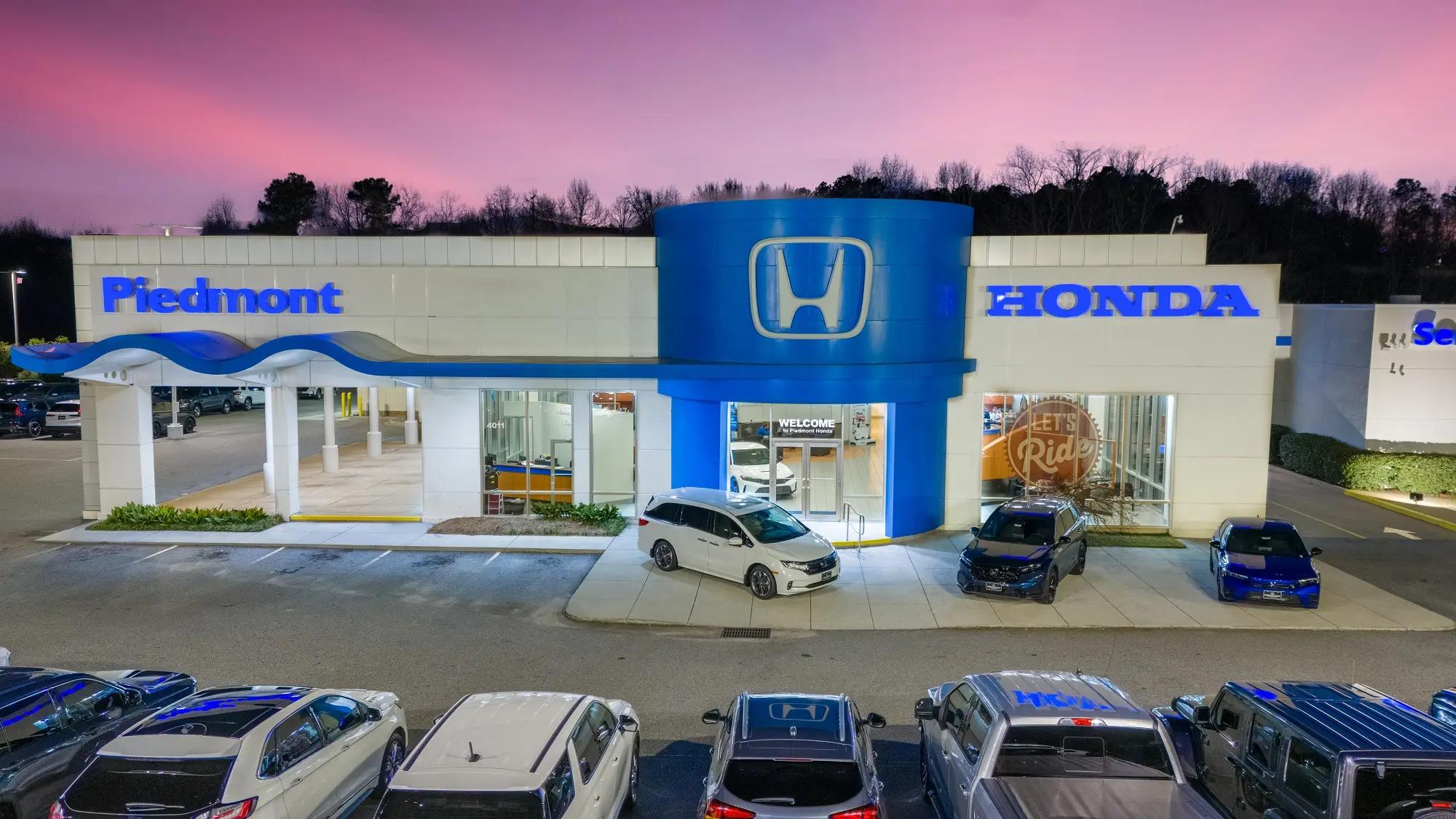
Honda Trade-In Value Guide: Expert Appraisal Insights with Sales Manager James Moore
Calculating your Honda trade-in value requires evaluating real-time wholesale and retail transaction data alongside specific vehicle parameters, including model year, trim tier, mechanical condition, recorded mileage, and installed options packages. Market guides establish an initial baseline range, which an in-person vehicle appraisal refines by inspecting reconditioning requirements and local pre-owned inventory demand. To review your current vehicle equity or start planning your next vehicle upgrade, visit our Anderson showroom location or give our team a quick phone call. We sat down with James Moore, Sales Manager at Piedmont Honda, who brings 12 years of automotive retail experience to explain how appraisals work, how condition impacts values, and how state tax rules affect your bottom line.
Q: How do I calculate the trade-in value of my Honda?
A: Determining your vehicle's baseline trade-in value starts with compiling core specifications such as exact mileage, trim level, factory option packages, and accident history, then comparing those details against current market sales databases. Online valuation tools from industry resources aggregate wholesale auction figures and recent retail transactions to generate a realistic price window.
While algorithmic valuation tools deliver a solid foundation, an accurate final figure depends on local supply and demand dynamics. For instance, commuters navigating the Highway 123 corridor through Easley often seek fuel-efficient compacts and midsize crossovers, which drives strong regional trade-in demand for those specific pre-owned models. An in-person valuation confirms mechanical soundness, tire wear, paint condition, and interior cleanliness to convert a broad estimate into a binding cash or trade-in offer.
Q: How does vehicle condition and maintenance history affect Honda appraisal values?
A: Physical and mechanical condition directly dictates where a vehicle falls within appraisal tiers, which typically range from Fair to Excellent based on the reconditioning costs required to make the car lot-ready. Minor cosmetic flaws like light door dings or minor bumper scuffs slightly adjust the valuation, but major body damage, worn suspension components, or mechanical issues require significant reconditioning investment that reduces the final trade-in offer.
Documented maintenance records play an equally important role during the evaluation process. A comprehensive service history proving timely oil changes, fluid flushes, and tire rotations gives appraisers full confidence that the powertrain has been properly maintained, minimizing resale risk. This documentation helps position your vehicle at the upper threshold of its market tier, allowing you to maximize value whether you plan to step into our latest new Honda inventory or explore our pre-owned vehicle selection.
When evaluating compact models like the 2026 Honda Civic lineup, trim levels and powertrain configurations also establish clear valuation benchmarks. Base trims like the LX CVT start at $24,695 MSRP, while the Sport CVT sits at $26,695 MSRP. Upgrading to advanced hybrid technology brings the Sport Hybrid CVT to $29,395 MSRP and the top-tier Sport Touring Hybrid CVT to $32,395 MSRP, alongside the manual enthusiast Si trim at $31,495 MSRP, with each trim subject to a $1,295 destination charge that factors into original valuation baselines.
Q: What feature packages and trim options increase Honda resale value?
A: Highly desirable factory packages and upgraded trim configurations consistently retain a higher percentage of their original cost compared to base models. Factory all-wheel drive systems, leather-trimmed seating, power moonroofs, upgraded touchscreen infotainment systems, and advanced driver-assist suites like Honda Sensing significantly boost resale appeal because pre-owned buyers actively seek these comfort and safety features.
Powertrain choices also heavily influence long-term equity performance. Highly efficient hybrid variants and durable automatic transmissions command strong market retention due to lower operational costs and high buyer demand. Buyers who initially chose well-equipped mid-tier or upper trims recover a substantial portion of that initial investment at trade-in time, especially when turning in a model that qualifies for certified pre-owned Honda inventory standards.
Vehicles outfitted with practical utility options also see sustained demand in regional outdoor markets. A crossover equipped with a factory trailer hitch or roof rails appeals directly to drivers heading out to Lake Greenwood for weekend boating and camping trips, giving those well-specified vehicles a distinct valuation edge during appraisal.
"Documented routine service and high-demand trim packages turn a standard trade-in into a top-tier asset on our lot."
Q: Is it better to trade in a Honda or sell it privately?
A: Trading in a vehicle at an established dealership provides maximum convenience, legal protection, and immediate transaction completion, whereas selling privately generally nets a slightly higher gross purchase price at the expense of considerable time and personal effort. Private sales often yield a higher nominal price tag, but sellers must manage online listings, screen potential buyers, handle test drive safety, verify funds, and manage title transfers independently.
Trading in eliminates those operational hassles and financial risks entirely. When you bring your vehicle to a dealer, the appraisal process takes minutes, the payout or trade equity is applied immediately, and all legal liability regarding the vehicle's title and future operation transfers to the store upon sale.
To streamline the transition into your next vehicle, you can start the process from home by using our tool to value your trade online. Establishing your trade equity early helps simplify the purchasing path before submitting a credit application for your new vehicle financing.
Q: How does trading in a Honda save on South Carolina sales tax and infrastructure fees?
A: Trading in a vehicle in South Carolina offers a direct financial incentive by lowering the total taxable purchase price of your replacement vehicle. State law mandates that the trade-in allowance granted by the dealership is subtracted from the gross sales price of the new vehicle before calculating vehicle sales fees.
South Carolina levies a 5% Infrastructure Maintenance Fee (IMF) on vehicle purchases, which is capped at a maximum of $500. By deducting your trade-in value from the negotiated price of the replacement vehicle, you significantly lower the net purchase amount subject to this 5% calculation. In many cases, a substantial trade-in credit reduces the taxable balance enough to lower the required fee well below the $500 cap, keeping more money in your pocket compared to an outright purchase following an independent private sale.
Q: How do Honda trade-in values compare against Subaru and other SUV competitors?
A: Honda models rank among the industry leaders in value retention, consistently outperforming many competitor brands across compact, midsize, and crossover segments. Independent vehicle valuation authorities like Kelley Blue Book recognized this long-term retention by naming the Honda Civic the 2026 Best Resale Value winner in the compact car category, while the Honda CR-V captured top honors in the compact SUV category.
While industry data projects that the average model-year vehicle retains roughly 45% of its original value after five years of ownership, top-performing Honda models are projected to retain 55% or more over the same duration. While competitor models from brands like Subaru hold strong value in niche all-wheel drive SUV categories, Honda maintains broader resale strength across sedans, hatchbacks, three-row family SUVs like the Honda Pilot, and hybrid crossovers. This sustained demand ensures strong appraisal offers when owners decide to upgrade.
Q: Can you trade in a Honda if you owe more than it is worth?
A: Trading in a vehicle with negative equity—meaning your remaining auto loan balance exceeds the current appraisal value of the car—is a straightforward process that dealerships handle regularly. In these scenarios, the difference between your payout amount and the trade-in allowance is calculated, and options are made available to clear the remaining balance.
The most common solution involves rolling the remaining negative equity directly into the financing structure of your replacement vehicle, subject to lender approval and credit guidelines. Alternatively, buyers can pay the difference out-of-pocket at the time of sale to clear the title completely. Our finance team works directly with primary lenders to structure options that keep your monthly payments manageable while moving you into a newer, more reliable vehicle.
If you are ready to evaluate your current loan balance against your car's market value, stop by our showroom address on Clemson Boulevard or call our team directly at (864) 305-4173. We will perform an in-person appraisal, review your payoff details, and help you map out the most cost-effective path toward your next vehicle purchase.
Pricing
Pricing by trim
| Feature | LX CVT | Si | Sport CVT | Sport Hybrid CVT |
|---|---|---|---|---|
| Base MSRP | $24,695 | $31,495 | $26,695 | $29,395 |
| Destination charge | $1,295 | $1,295 | $1,295 | $1,295 |
Pricing (continued)
| Feature | Sport Touring Hybrid CVT |
|---|---|
| Base MSRP | $32,395 |
| Destination charge | $1,295 |
Keep Your Vehicle Running Strong
Keep your vehicle performing at its best with our service team:
