

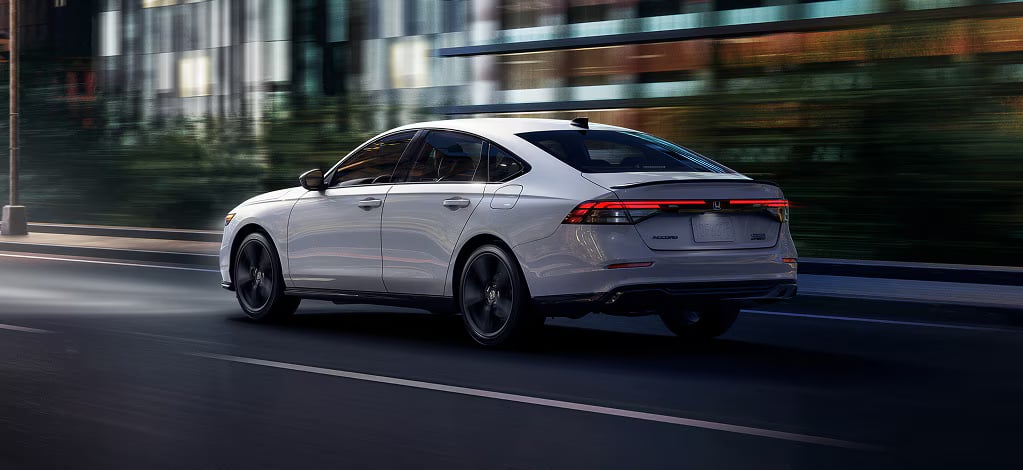
Honda hybrid vehicles earn high reliability marks through proven engineering, backed by an 8-year/100,000-mile high-voltage battery warranty and an electronic direct-drive setup that eliminates traditional automatic transmission bands and torque converters. Essential components like the 2.0-liter four-cylinder engine and electric drive motors operate under reduced mechanical stress, helping drivers achieve hundreds of thousands of dependable miles with basic routine care.
Long-term dependability comes down to how the powertrain manages wear. Because the electric propulsion motor handles initial acceleration and low-speed driving, the gasoline engine experiences fewer hard cold starts and abrupt RPM spikes. Regenerative braking captures kinetic energy to slow the vehicle, which significantly reduces wear on mechanical brake pads and rotors.
Drivers traveling between Greenwood and Anderson across the rolling hills of the Piedmont region routinely see how well these systems handle daily commuting. First-time hybrid buyers stepping onto our lot often ask whether battery longevity rivals traditional gas engines. Real-world feedback and factory testing show that lithium-ion battery packs comfortably endure years of daily cycling without major capacity loss.
If you are ready to explore the lineup in person, explore our new Honda lineup online, give our team a call at (864) 305-4173, or visit our showroom on Clemson Boulevard to take a test drive.
Table of Contents
- How Does the Honda Two-Motor Hybrid System Work on Daily Drives?
- Which Honda Hybrid Gets the Best Gas Mileage and Horsepower?
- What Are the Cargo Space and Fuel Economy Specs for the Honda CR-V Hybrid?
- Which Is Better: The Honda CR-V Hybrid or Toyota RAV4 Hybrid?
- How Long Is the Factory Hybrid Battery Warranty and What Maintenance Is Included?
- Common Questions About Popular Honda Hybrid Models
How Does the Honda Two-Motor Hybrid System Work on Daily Drives?
Honda's two-motor hybrid system operates by pairing a 2.0-liter four-cylinder Atkinson-cycle engine with two electric motors—a propulsion motor and a generator motor—to drive the wheels smoothly without a conventional automatic transmission. The system automatically switches between three distinct operating modes based on speed, battery charge, and throttle input.
During low-speed city driving or light acceleration, the vehicle runs in EV Drive, drawing power solely from the lithium-ion battery to power the electric propulsion motor. When more power is demanded, the system transitions into Hybrid Drive. In this mode, the gasoline engine spins the generator motor, which creates electricity to feed the electric propulsion motor while excess energy tops off the battery. At sustained highway cruising speeds, a lock-up clutch engages Engine Drive, directly connecting the gasoline engine to the drive wheels where internal combustion operates at its peak thermodynamic efficiency.
Shoppers frequently ask whether a Honda hybrid can drive on electric power alone. The powertrain operates on pure electric energy for short distances at low speeds, during light coasting, or while idling in traffic. Drivers never have to manually select these modes; the onboard power control unit calculates the optimal power source every millisecond.
For buyers evaluating budget-friendly entry points into electrified driving, browsing our pre-owned hybrid selection provides a great opportunity to test out Honda's dual-motor driving dynamics across recent model years.
Which Honda Hybrid Gets the Best Gas Mileage and Horsepower?
The Honda Civic Hybrid delivers the highest combined fuel economy and energetic output in the compact lineup, achieving up to 50 mpg city / 47 mpg highway / 49 mpg combined in sedan body styles while producing 200 horsepower and 232 lb-ft of torque.
The midsize Honda Accord Hybrid pairs the same basic powertrain architecture with a larger cabin footprint. Available in Sport, EX-L, Sport-L, and Touring trims, the Accord Hybrid generates 204 horsepower and 247 lb-ft of torque. The EX-L trim earns an EPA rating of 51 mpg city / 44 mpg highway / 48 mpg combined, making it the highest city-mpg hybrid sedan in the lineup. The Sport, Sport-L, and Touring trims carry EPA ratings of 46 mpg city / 41 mpg highway / 44 mpg combined due to their larger wheel and tire packages.
| Model | Body Style | Combined Horsepower | Torque | EPA Fuel Economy (City/Hwy/Comb) |
|---|---|---|---|---|
| Civic Sport Hybrid | Sedan | 200 hp | 232 lb-ft | 50 / 47 / 49 mpg |
| Civic Sport Hybrid | Hatchback | 200 hp | 232 lb-ft | 50 / 45 / 48 mpg |
| Accord EX-L Hybrid | Sedan | 204 hp | 247 lb-ft | 51 / 44 / 48 mpg |
| Accord Sport / Touring Hybrid | Sedan | 204 hp | 247 lb-ft | 46 / 41 / 44 mpg |
Commuters heading toward the Blue Ridge foothills from Easley appreciate how instantly the electric propulsion motor delivers off-the-line torque when merging onto fast highway ramps. Drivers trading in an older vehicle can easily value your trade online to see how current vehicle equity applies toward upgrading to a high-efficiency sedan.
What Are the Cargo Space and Fuel Economy Specs for the Honda CR-V Hybrid?
The Honda CR-V Hybrid offers about 36 cubic feet of rear cargo space behind the second row, which expands to nearly 77 cubic feet when the 60/40 split rear seatbacks are folded flat. Front-wheel-drive versions achieve an EPA-estimated 43 mpg city / 36 mpg highway / 40 mpg combined, while all-wheel-drive configurations achieve 40 mpg city / 34 mpg highway / 37 mpg combined.
Offered in Sport, TrailSport, Sport-L, and Sport Touring trims, the CR-V Hybrid combines utility with standard Real Time AWD on TrailSport and Sport Touring models. The rugged TrailSport trim, equipped with all-terrain tires and off-pavement tuning, is EPA-rated at 38 mpg city / 33 mpg highway / 35 mpg combined.
A recurring question among SUV shoppers is whether the CR-V Hybrid includes a spare tire. To make room for the high-voltage battery pack beneath the rear floorboard without reducing passenger legroom or cargo volume, Honda equips the CR-V Hybrid with a tire sealant and repair kit rather than a physical spare tire.
The flat cargo floor, wide tailgate opening, and low lift-over height make loading luggage, camping gear, or groceries straightforward. You can apply for pre-approval online to outline your budget before stopping by to check out the cabin layout in person.
Which Is Better: The Honda CR-V Hybrid or Toyota RAV4 Hybrid?
The Honda CR-V Hybrid holds a distinct edge over the Toyota RAV4 Hybrid in interior space, passenger comfort, and power delivery refinement. Producing 204 horsepower and 247 lb-ft of torque, the CR-V Hybrid uses its direct-drive two-motor setup to accelerate smoothly without the high-RPM engine drone often associated with power-split hybrid transmissions.
Inside the cabin, the CR-V Hybrid provides 41 inches of rear legroom, giving back-seat passengers noticeably more stretching room than the RAV4 Hybrid. Rear cargo capacity is equally competitive, with the CR-V offering up to nearly 77 cubic feet of maximum volume compared to the RAV4's about 70 cubic feet.
While the RAV4 Hybrid offers slightly higher overall EPA combined fuel economy figures, the CR-V Hybrid counters with superior front-seat ergonomics, larger touchscreen options, and standard Honda Sensing active driver-assist technology. The CR-V Hybrid's wide windshield pillars and body-stabilizing front seats minimize fatigue during long road trips, making it the preferred choice for drivers who value ride quality and interior comfort.
How Long Is the Factory Hybrid Battery Warranty and What Maintenance Is Included?
The factory warranty for Honda's high-voltage hybrid batteries spans 8 years or 100,000 miles, ensuring comprehensive coverage against defects and performance issues. Basic new-vehicle coverage lasts for 3 years or 36,000 miles, while the powertrain is backed for 5 years or 60,000 miles.
Every new Honda hybrid also comes standard with Honda Service Pass, which covers factory-scheduled maintenance for 2 years or 24,000 miles, whichever comes first. This complimentary program includes routine engine oil and filter changes, tire rotations, and multi-point inspections performed by factory-trained technicians.
Maintaining a Honda hybrid involves simple checks. Because the two-motor system handles power distribution electronically, there are no transmission belts or complex clutch packs to service. Regenerative braking reduces heat buildup on brake components, which extends the service life of brake pads.
If you are considering a certified model, exploring our certified pre-owned Honda vehicles gives you access to extended warranty protections and rigorous multi-point vehicle inspections. Current hybrid owners can also easily schedule a service appointment online for routine maintenance.
Common Questions About Popular Honda Hybrid Models
Drivers evaluating Honda's hybrid lineup often have practical questions regarding battery operation, flat tire procedures, and service expectations before making their decision.
Q: Does driving a Honda hybrid require special home charging equipment?
Standard Honda hybrid models like the Civic Hybrid, Accord Hybrid, and CR-V Hybrid are self-charging hybrid electric vehicles that do not plug in. The 2.0-liter four-cylinder engine and regenerative braking system automatically recharge the onboard battery while you drive, eliminating the need for home Level 2 chargers or wall outlets.
Q: What happens if a Honda CR-V Hybrid gets a flat tire without a spare?
Because the high-voltage hybrid battery resides under the rear cargo floor, the CR-V Hybrid includes an emergency tire repair and sealant kit under the cargo tray. For roadside tire damage that cannot be sealed, drivers can access Honda Roadside Assistance: 1-800-835-9421 for 24/7 towing to the nearest authorized service center throughout the warranty period.
Q: Can cold weather affect the fuel efficiency of a Honda hybrid?
Cold weather can temporarily lower fuel economy because the engine runs longer to heat the passenger cabin and bring the high-voltage battery up to its ideal operating temperature band. In mild southern climates, efficiency fluctuations are minimal compared to severe northern winter regions.
Q: Is the maintenance cost higher on a Honda hybrid than a gas-only vehicle?
Routine maintenance costs are generally equivalent or lower than gas-only models. Regenerative braking reduces wear on mechanical brake pads, and the included Honda Service Pass covers basic oil changes and tire rotations for 2 years or 24,000 miles.
Q: Can I drive a Honda hybrid if the high-voltage battery is low?
The vehicle's power management software keeps the high-voltage battery within a safe charge window. If the battery charge drops during heavy load or prolonged idling, the 2.0-liter four-cylinder engine automatically turns on to drive the generator motor and recharge the battery.
If you have additional questions about electrified models, review our guide to frequently asked customer questions, give our team a call at (864) 305-4173, or stop by our Anderson dealership today to explore our full inventory.
© 2026 Piedmont Honda. All rights reserved.
